
A Fatwa Is One Scholar's Opinion, Not the Final Word on Crypto

ShariaQuant Team
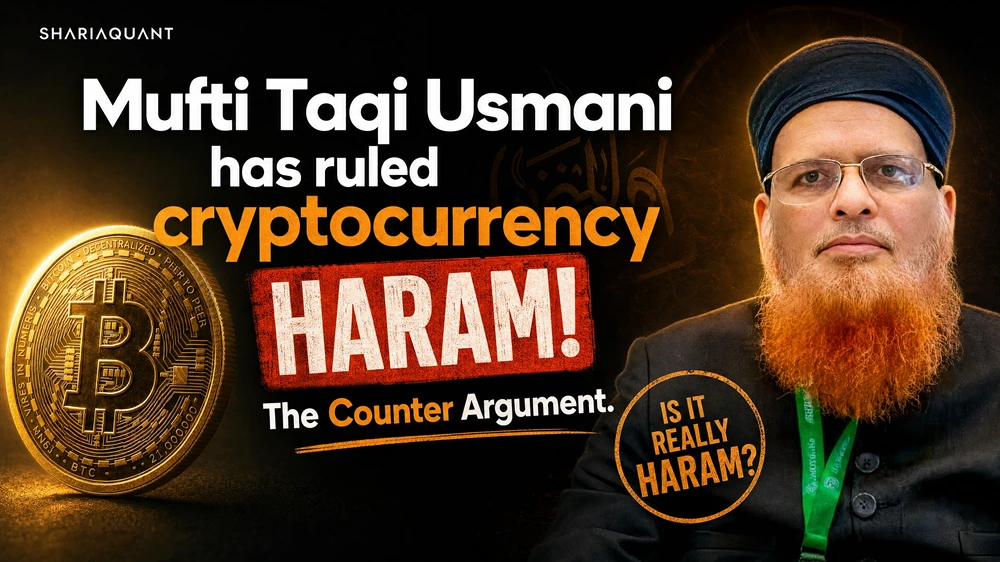
Mufti Taqi Usmani has ruled cryptocurrency impermissible. With full respect for the Shaykh, here is why many Muslims after doing their own research, see spot investing differently.
This week, a ruling went around the Muslim world like wildfire. Mufti Muhammad Taqi Usmani, one of the most respected living authorities in Islamic finance, former chairman of the AAOIFI Shariah Board, and a towering figure of the Hanafi tradition issued a fatwa, circulated under Darul Uloom Karachi, declaring that cryptocurrency does not qualify as māl (wealth or property) in Islam. Because it isn't wealth, the ruling concludes, buying and selling it is impermissible. And it doesn't stop at Bitcoin: it explicitly extends to tokens and even stablecoins like USDT, and states that changing the name of a "coin," "token," "stablecoin" doesn't change the ruling.
I want to be clear from the first line: I hold Mufti Taqi Usmani in the highest esteem. His contribution to Islamic finance is immense, and no one writing an article on their phone gets to wave that away. But I also want to say something that too many Muslims have forgotten how to say respectfully:
A fatwa is not the same thing as the Law.
What a fatwa actually is
There is the Shariah — the Law, which belongs to Allah. And then there is fiqh, the human effort to understand that Law. A fatwa lives in the second category. It is a qualified scholar's ijtihad: his reasoned opinion, arrived at by applying principles to a question. It is serious, it is weighty, and it deserves respect. But it is a human judgment, and human judgments on new questions can differ, which is exactly why, across fourteen centuries, our greatest imams disagreed with each other constantly, and considered that disagreement a mercy, not a scandal.
Cryptocurrency is a nāzila, a genuinely new issue with no direct text in the Qur'an or Sunnah addressing it. That means every position on it, including Mufti Taqi's, is ijtihad. Not revelation. Ijtihad. And when something is ijtihad, no scholar, however senior, is to be followed blindly. Allah gave every one of us an intellect and made seeking knowledge an obligation. We are allowed to read, to research, to weigh the evidence of scholars on all sides, and to understand why before we accept or reject. That isn't arrogance toward scholars. That's the responsibility they themselves carried.
So let me do exactly that.
Where I completely agree with the Shaykh
Let's not pretend the fatwa is attacking a phantom. A huge amount of what happens under the banner of "crypto" is genuinely, unambiguously haram, and I will not defend a single bit of it:
- Futures, margin, and leverage trading, betting borrowed money on price direction, is gambling (maysir/qimar). It is haram. Full stop.
- Pump-and-dump coins and scam tokens with no product, no utility, and no purpose except to enrich insiders and fleece latecomers, that is pure speculation and deception. Haram.
- Interest-bearing "crypto" products, lending schemes and protocols promising a fixed, guaranteed yield on your principal, smell exactly like riba, because they usually are.
If the fatwa were only about this, I would be handing out copies myself. On the casino, on the leverage, on the scams, the Shaykh is right.
Where I respectfully differ: Solana is closer to Apple than to a lottery ticket
The heart of the ruling is the claim that crypto is not māl. This is where I part ways and, notably, this is the most madhhab-specific part of the whole argument.
The classical Hanafi definition of māl leans heavily on tangibility: something you can physically grasp. That is precisely why a Hanafi jurist is the most likely of all to say a digital asset "isn't wealth." But that is not the only view in our tradition, nor even the dominant one today. The Maliki, Shafiʿi, and Hanbali schools, and major contemporary jurists like Shaykh Wahbah al-Zuhayli and Shaykh Yusuf al-Qaradawi, hold that māl includes anything of recognized value that can be owned and stored, tangible or intangible, as long as custom (ʿurf) treats it as valuable.
And here is the part nobody can dodge: on that basis, the entire modern Islamic-finance world already treats intangibles as wealth. Copyrights, patents, trademarks, and the goodwill of a business are all bought and sold as māl today precisely because ʿurf recognizes their value. Company shares are traded as māl even though a share is just a claim, not a physical object you hold in your hand. If a trademark and a share certificate can be wealth, on what principled basis is a productive digital network not?
Because that is what a real utility token is. Solana for instance, isn't an imaginary number, it's a stake in a working economy. The Solana network processes real transactions, hosts real applications, and serves real users and developers. As adoption grows, activity on the network grows, demand for the token grows, and its value appreciates. That is not a wager decided by chance. That is the exact same logic by which an Apple share appreciates when Apple sells more iPhones. Ethereum is the same story. These are ownership stakes in productive systems, not tickets in a game of luck.
So no, I don't accept that a coin like this is categorically "not wealth." It behaves like wealth, it is priced like wealth, it is owned and stored like wealth, and millions of people treat it as wealth. That is the definition of māl for most of our scholars.
Not all coins are equal, and that's the whole point
The weakness of a blanket ruling is that it flattens a landscape that isn't flat. The honest Muslim question was never "crypto: yes or no?" It's which crypto, and how.
A coin with genuine utility, backed by a functioning network and real usage, held on a spot basis with no leverage and no interest, is a completely different creature from a memecoin built on hype, or a token whose entire mechanism is disguised riba. Lumping Solana, a fixed-supply store of value like Bitcoin, a garbage pump-and-dump, and a fixed-yield lending scheme into one word as "crypto" and issuing one ruling for all four is like judging "the stock market" as a single thing without distinguishing Aramco from a penny-stock fraud. The category isn't the issue. The structure of the specific asset is. That distinction, utility vs. speculation, ownership vs. riba that is the entire discipline of screening, and it's why I built what I built.
The elephant in the room: what about the money already in your pocket?
Here is the question I most want my Muslim brothers and sisters to sit with. If we are going to declare an asset impermissible because it isn't ideal, God-approved money, let's apply that microscope evenly.
There is no truly Shariah-governed state on earth today issuing a halal currency. The money we all use, the money in your bank account right now is fiat: backed by nothing, printed at will, and eroded by inflation by design. The global financial system it sits inside runs, from top to bottom, on riba, and is dominated by a handful of immensely powerful institutions that answer to no ummah. Many honest critics argue that much of what is even marketed as "Islamic banking" merely replicates that interest-based machinery with different labels.
We can't practically escape it, either. You can't buy groceries with a dirham of gold or a coin of silver in a modern economy. Even our "digital gold" and our PayPal transfers ultimately settle in US dollars. We are all already deep inside a monetary system that, judged by the strictest standard, is riddled with exactly the problems now being aimed at crypto.
So I ask, sincerely and without disrespect: if the objection is inflation, absence of backing, and a system detached from real value and soaked in riba — then a decentralized, fixed-supply asset that is created without interest and cannot be printed into oblivion is arguably closer to the Islamic monetary ideal than the fiat we accept every single day without a second thought. A consistent standard has to point in every direction, not just at the newcomer.
Some scholars agree with the Shaykh. Many do not.
This is the part the viral headlines leave out. The Muslim world is not united behind a single ruling here is genuinely divided, and both sides are populated by serious, qualified people.
On the restrictive side, alongside Mufti Taqi Usmani, sit Egypt's Dar al-Ifta, Turkey's Diyanet, Indonesia's MUI, and the Syrian Islamic Council, largely citing speculation, volatility, lack of state backing, and misuse.
On the permissive side sit no less serious names: Darul Uloom Zakariyya in South Africa and senior scholars like Mufti Radha ul-Haqq and Shaykh Taha Karaan, who hold that Bitcoin is māl and permissible because society has accepted it. Mufti Faraz Adam argues that utility tokens serve a real function in their ecosystems and qualify as wealth through custom. Shaykh Ziyaad Mahomed, a Shariah board chairman in Islamic banking, notes that the Shariah never required money to have intrinsic value, social acceptance is enough. Their recurring conditions are precisely the ones I already live by: spot only, no leverage, no interest, no pure speculation.
check https://shariaquant.com/fatwas for more scholarly opinions
This is not fringe versus consensus. It is ijtihad versus ijtihad. And on a matter of ijtihad, a Muslim is permitted to follow a qualified scholar whose reasoning he finds sounder, as long as he does so honestly, knowing the other view exists and respecting the people who hold it.
My conclusion
I am not issuing a counter-fatwa. I am not a mufti, and this article is not a ruling. What I am doing is refusing to accept that a single opinion, however eminent the man who holds it, closes a question that our own tradition treats as open.
Respect Mufti Taqi Usmani. Read him carefully. Then respect the scholars who disagree with him, read them carefully and then do the thing Islam actually asks of you: use the mind Allah gave you. Learn why one scholar says impermissible and another says permissible. Distinguish the scam coin from the productive network. Stay away from the casino of leverage and the trap of riba. And make your decision as someone who understood the arguments, not as someone who merely heard a headline.
A fatwa is one scholar's best effort to understand the Law. It is not the Law itself. Knowing the difference isn't disrespect it's the responsibility every believer carries.
By Wais — Founder, ShariaQuant
This article reflects the personal research and opinion of the author. It is not a fatwa or a religious ruling, and it is not financial advice. On matters of Islamic law, seek out qualified scholars ideally more than one and weigh their reasoning for yourself. May Allah guide us all to what is correct.