Bitcoin: The Anti-Riba Money
ShariaQuant Research Board
Islamic Finance & Quantitative Cryptography
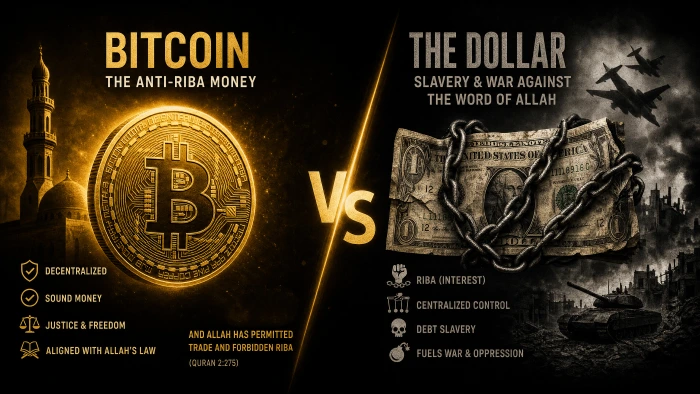
Right now, as you read this, your money is working. But not for you!
The savings sitting in your bank account aren't sitting safely in a vault. The bank has lent them out, three, five, ten times over and every one of those loans carries interest (Riba). Your money is the fuel. And the fire it feeds is the one thing Allah declared war over.
Most of us never signed up for this. We just opened an account because that's what you do. We took the mortgage because how else do you buy a home. We swiped the card, paid the "minimum," financed the car. Nobody sat us down and explained that we had quietly become a cog in the largest riba machine in human history. At the same time, some of us knew what it is, and we said; How else Muslims are gonna grow? Stop these old talks! We even found a Mufti to give fatwa for it. Imagine that!
So let's have that conversation now.
What Allah and His Messenger ﷺ actually said
Riba isn't a minor sin tucked away in the fine print of the deen. It's condemned in the Qur'an with a severity reserved for almost nothing else.
Allah says in Quran: He permitted trade and forbade riba (al-Baqarah 2:275). Trade is honest exchange, you give value, you take value, both walk away in good shape. Riba is money birthing money with no work, no risk, no value created. One is halal. The other is a poison.
And then comes the verse that should stop every believing heart:
"If you do not desist, then be informed of a war from Allah and His Messenger." al-Baqarah 2:279
Read that again. War. From Allah. From the Prophet ﷺ himself. There is no other sin in the Qur'an that carries this exact language, a personal declaration of war against the one who refuses to leave it.
The same passage warns that those consumed by riba will rise on the Day of Judgment like a man driven to madness by the touch of Shaytan. In Surah Al-Imran (3:130), we're forbidden from devouring riba "doubled and multiplied." In Surah Ar-Rum (30:39) — one of the earliest revelations on the subject — Allah tells us that whatever we give in riba to increase our wealth does not increase in His sight, while what we give in charity multiplies.
The Prophet ﷺ made it heavier still. He named riba among the seven destructive sins "the mubiqat" right alongside shirk and murder (Bukhari and Muslim). And in Sahih Muslim, Jabir ibn Abdullah reported that the Messenger of Allah ﷺ cursed the one who consumes riba, the one who pays it, the one who records it, and the two who witness it and said they are all the same.
All the same. Not just the banker getting rich. The one who signs. The one who writes the contract. The one who stands by and lets it happen.
There are narrations, reported in collections like Ibn Majah and Ahmad, that describe riba as having many doors, the least of which is worse than a man committing zina with his own mother and that a single dirham of it knowingly consumed is worse than committing adultery dozens of times over. Scholars differ on the grading of some of these, so I won't build any conclusion on them. But even setting them aside completely, the Quran alone "a war from Allah" is enough to make a serious Muslim lose sleep.
We are all in it, and most of us don't even know!
Here is the uncomfortable part. You can pray five times a day, fast every Ramadan, give your zakat, and still be feeding the exact system Allah declared war on without ever seeing a single interest payment land in your bank account.
How? Because the modern financial system is built on riba at the foundation, not just the surface.
Think about what money even is today. A dollar, a pound, a rupee? it isn't backed by gold or silver or anything real. It's created out of nothing, as debt, the moment someone takes out a loan. The bank types a number into a screen and lends money it never had. That new "money" enters the world already owing interest. The entire supply of currency you use every day was, quite literally, borrowed into existence at interest.
So when you hold fiat, you are holding an IOU inside a debt based, interest based machine. When you deposit your salary, the bank multiplies it and lends it out at riba. When inflation eats 5, 10, 20% of your savings, that silent erosion is a hidden tax, a quiet form of theft against the saver, engineered by a system that must constantly print and lend to survive.
And Islam has always cared about hard work, honest money & Halal Money. Allah swrt condemns those who cheat the scales: "Woe to those who give short measure" (al-Mutaffifin 83:1). He raised the balance "the mizan" and commanded us not to fall short in it (ar-Rahman 55:8-9). A currency that is silently debased year after year is a rigged scale. It is short measure by design. It is the modern tatfif.
Once you see it, you can't unsee it. The savings account. The credit card you "pay off every month." The interest-bearing student loan. The pension quietly parked in riba based bonds. The car finance. Even just holding your wealth in a currency built to lose value. We are swimming in it. The Prophet ﷺ warned of exactly this time: a day when riba would cover the people so completely that even the one who avoids it will be touched by its dust.
That dust is on all of us. The question is whether we are willing to walk out of the storm.
Enter Bitcoin
In 2008, the global financial system nearly collapsed under the weight of its own riba. And what did the powerful do? They printed and bailed out the banks, rewarding the very people who lit the fire, and handing the bill to ordinary families through inflation and debt.
Months later, in January 2009, an anonymous figure named Satoshi Nakamoto launched Bitcoin. And in the very first block, the genesis block, the foundation stone of the entire network, he left a message permanently carved into the code. A newspaper headline:
"The Times 03/Jan/2009 Chancellor on brink of second bailout for banks."
Read that and understand what it means. Bitcoin was not born as a get-rich scheme. It was born as a protest against the bailout, debt-based, riba-soaked system. It was designed, from its first breath, to be the exit door.
So why does it deserve the name anti-riba money?
Because it is not created through debt. No bank types Bitcoin into existence and attaches interest to it. Every coin is mined according to a fixed, transparent, unchangeable schedule that no king, no central bank, and no government can alter. Nobody borrows it into being. It is not an IOU. It is not somebody else's liability. When you hold Bitcoin, you hold the thing itself — not a promise from a system at war with Allah.
Because it cannot be debased. There will only ever be 21 million bitcoin. The supply is capped, honest, and knowable by anyone. Roughly every four years, the rate of new coins is cut in half, tightening toward that hard limit. Compare that to fiat, which can be printed into oblivion at the press of a button. Bitcoin is the honest scale the Qur'an demands, a mizan that cannot be tampered with, a measure that no one can shorten. In a world of rigged scales, it is fixed weights and true measure.
Because it needs no permission. You can hold it, send it, and receive it without a bank standing between you and your own wealth. No middleman skimming riba off the top. No institution lending your money out from under you. You become the vault. You become the bank.
The deepest reason Bitcoin matters to a Muslim isn't the price. It's that it lets you step outside the debt machine entirely, to hold and move wealth in a form that isn't built on interest, isn't borrowed into existence, and can't be silently stolen through inflation.
"But is Bitcoin even halal?" — let's address it head-on
I'm not going to pretend the scholarly conversation doesn't exist, because a thinking Muslim deserves honesty, not hype.
Yes, scholars have debated Bitcoin. Some raise concerns about gharar, excessive uncertainty, because of its volatility. Others have looked closely and concluded it functions as legitimate property (mal) and a medium of exchange, and that its permissibility is sound. The conversation is real, it's ongoing, and it's maturing fast and increasingly, the very property we're discussing here (that it's honest, finite, non-debt money) is why more scholars are growing comfortable with it.
But hear this clearly, because it's where people trip: holding Bitcoin does not automatically make your wealth halal. Bitcoin is a tool. You can still take that tool straight back into riba if you're careless.
The "earn 8% on your crypto" products? That's riba. Lending your coins for a guaranteed yield? Riba. Leverage, margin, and futures trading? That's gambling (maysir) wrapped in interest, and it's exactly the trap that ruins people. Buying Bitcoin does nothing for you if you then hand it to a platform that pays you interest on it. You'd be escaping the fiat riba machine only to build a smaller one of your own.
The point was never "Bitcoin therefore halal." The point is that Bitcoin, held and used correctly: spot only, no leverage, no interest products, in your own custody, lets you finally hold wealth outside the debt-based, riba-based system. That is the escape. But the discipline is on you.
How to actually adopt the halal way?
Don't rush. Don't gamble. Don't put yourself in a position that keeps you up at night. Here's the better path:
Learn before you buy. Islam warns against jumping into what you don't understand. Read, watch, ask, study. Understand what Bitcoin is and why it matters before a single dirham goes in. Ignorance is its own kind of gharar.
Start small. You don't need to move your whole net worth overnight. Begin with an amount you can afford to hold for years without stress, and build understanding as you build a position.
Buy and hold, spot only. No margin. No leverage. No futures. No "trading" that's really just gambling. This is where most people destroy themselves and their wealth. Own the actual coins. Think in years, not days.
Take self-custody. "Not your keys, not your coins." Wealth left on an exchange isn't fully yours, it's a promise from a company, and companies collapse. Learn to hold your own keys in your own wallet. This is sovereignty. This is the whole point.
Avoid every interest-bearing product. No lending, no "yield," no staking-for-guaranteed-returns schemes, no borrowing against it. The moment interest enters, you've walked back into the fire you were trying to leave.
Dollar-cost average and be patient. Buy steadily over time instead of trying to time the market. Treat it as a long-term store of honest value, not a lottery ticket. Patience (sabr) is a virtue here, not just financially but spiritually.
How to raise awareness in the ummah
Knowledge you keep to yourself is a trust you're failing. If you understand this, you have a duty to help others see it too but with wisdom (hikmah), not judgment.
Start with mercy, not condemnation. Most Muslims in riba have no idea they're in it. They inherited an account and a mortgage and a card, and no one ever taught them otherwise. Don't shame them. Open their eyes gently, the way you'd want yours opened.
Lead with the alternative. It's not enough to tell people what's haram; show them the halal way out and give them hope. Guilt paralyzes. A clear path forward inspires.
Bring it to the people you love first, your family, your spouse, your children. Teach the next generation about honest money before the system teaches them its habits.
Take it to the community. Talk about it in your circles, propose a study session at the masjid, invite a knowledgeable speaker, run a simple workshop. A single evening explaining how the money system actually works can change how someone handles their wealth for the rest of their life.
Create and share. Write, post, record, explain. Every honest piece of content you put out reaches someone who's never questioned any of this. This is da'wah for the modern age.
And root it in the deen, always. Anchor every conversation in the Qur'an and Sunnah, and point people toward scholars and proper knowledge. This isn't about hype or "getting rich." It's about obeying Allah with our wealth.
Why this is the way out
Muslims have looked for exits from riba before. Gold and silver are beautiful, honest money but governments have demonetized and even confiscated them within living memory, and they're hard to move and store in the modern world. "Islamic banking," for all its good intentions, too often ends up as a lightly repackaged version of the same debt-based system, still tethered to the fiat machine at its root. These aren't nothing but none of them let you fully step outside.
Bitcoin does. For the first time in modern history, an ordinary Muslim can hold and move real wealth that no central bank can print, no ruler can debase, no institution can lend out at interest behind your back, and no one needs to grant you permission to use. Money that isn't debt. Money that can't be quietly stolen from the saver. Money born, in its very first line of code, as a rejection of the bailout-and-riba world.
Is it the only thing a Muslim can ever touch? No! and anyone who tells you Bitcoin alone makes you righteous is selling you something. But as a genuine, complete exit from the debt-based riba system Allah declared war on? Nothing else comes close. It is, right now, the clearest door out of a burning building.
The battlefield in our time is the money itself. And for once, we have a way to lay down our support for the wrong side and pick up something honest instead.
Leave the riba. Choose sound money. Strive with knowledge, with patience, with sincerity for wealth that's clean when you finally stand before Allah.
That is the jihad of our generation. And the door is open.
This article is written for awareness and reflection, not as a fatwa. The permissibility of specific crypto assets is a live scholarly discussion seek knowledge, verify with qualified scholars, and never invest in anything you don't understand. And remember: Bitcoin only keeps your wealth clean if you keep it clean spot only, self-custodied, and far away from every interest-bearing product.