Halal Crypto Screener - ShariaQuant Beta 4

ShariaQuant Team
Screening what you actually own
Every version of our engine has asked two questions: is this project's business permissible, and is the money that reaches this token clean. Beta 4 adds a third that we had been taking for granted, and it turns out to come first.
Is this thing property at all?
Why we revisited the framework In 2026, Mufti Faraz Adam of Amanah Advisors published "Is Crypto Halal? The Definitive Shariah Guide to Crypto and Digital Assets." It is the most complete treatment of digital assets we have read, working from the classical sources on māl, manfaʿah, dayn and ḥuqūq down to what a private key actually controls. Readers who want the full argument should seek out the original; it is worth the time, and nothing here substitutes for it. Source: Is Crypto Halal?
The book does not publish a screening checklist. What it publishes is the reasoning. We tested our methodology against it line by line. Most held. Some had gaps. Beta 4 closes them.
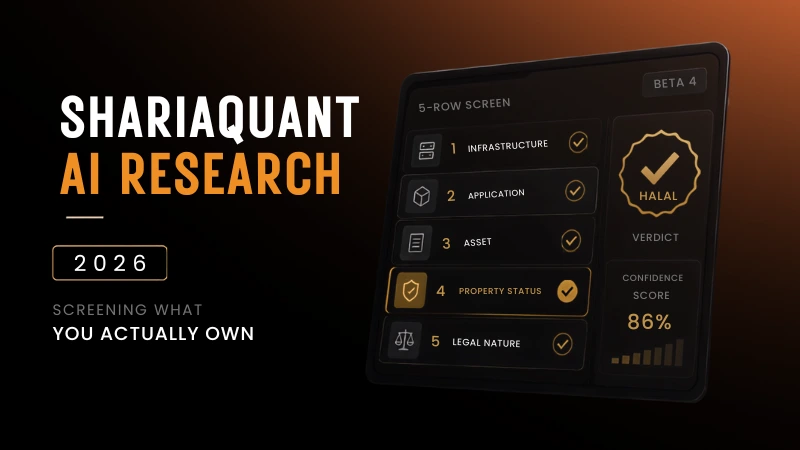
The three-layer screen The book screens an asset across three layers, and is strict about the arithmetic: a failure at any single layer fails the whole asset.
Infrastructure (where it runs): The base protocol and consensus, plus any secondary platform the asset depends on.
Application (what it does): The actual service the project delivers.
Asset (what you own), The token itself: its utility, economics, and legal nature.
We had been screening the second and third. We never screened the first as its own layer. Beta 4 adds it, and adds the fact-gathering to support it.
The layer carries an important restraint, written into the engine deliberately: a neutral, general purpose network that merely hosts many kinds of application does not disqualify the native asset of that protocol. Hosting is not endorsement. We do not downgrade a Layer 1 because strangers deployed a lending protocol on it. Only infrastructure built so that using the asset necessarily means engaging in unlawful activity fails.
All four screening tracks, crypto, tokenized stocks, presales and airdrops, now carry all five rows, because a tokenized share and a presale allocation are digital assets too.
The property gate
A digital asset is not property by default. In the book's framing it is a ḥaqq, an exclusive, protocol-recognised right of control over a ledger position which becomes māl ḥukmī, recognised property, only when conditions are met.
Mufti Taqi Usmani identified five conditions under which a right becomes tradable property, reproduced in the book, and Beta 4 screens against each: it must presently exist; be an original entitlement rather than a defensive right; be transferable; be defined and free from material ambiguity; and commercial custom must treat it as wealth.
Our engine now reports this as a Property Status row. Does the token presently exist on-chain? Can supply, issuance and holder rights be objectively ascertained, or is there retained mint authority, a freeze power, an upgradeable contract that can rewrite what holders own? Can the holder take exclusive control and transfer it? Is it dealt in as wealth by a real body of people?
The bar is deliberately low, and we keep it low. Following Imam Abū Ḥanīfah's method, a single genuine lawful use suffices even if it is not the dominant one. Volatility is not a property defect. Modest utility is still utility. We do not fail assets for being unfashionable.
But tamawwul is not conferred by a market price alone. A token positively established to have no use whatsoever, surviving only on the hope of resale can now fail. Previously our worst available outcome was Doubtful.
Position or claim
The book makes a point most screeners pass over: a token that is in substance an IOU or a claim against an issuer is governed by the rules of debt, however it is described.
Beta 4 therefore classifies every asset by legal nature rather than marketing: a native protocol position where nobody owes you anything; an issuer redemption claim, which is what most fiat-backed stablecoins actually are; or title to custodied property, such as tokenised gold.
Being a claim is not impermissible, and we do not fail an asset for it. What changes is disclosure. Where you hold a redemption claim, the report says so, names the issuer, and notes that your value depends on that issuer honouring it.
What changed in practice
The framework moved real verdicts.
Stablecoins → Doubtful. USDT, USDC, USDG, PYUSD. Holders receive no interest, so the old screen passed them. The property gate asks a different question, and the issuer's discretionary freeze power means control is not exclusive.
Exchange tokens → Doubtful. BNB, LEO, WBT. Permissible mechanics, neutral chains, but issued by operators running margin and lending desks.
Tokenized stocks → more Halal. Apple, Alphabet, Microsoft, Meta, Amazon now pass with a purification duty. Under AAOIFI, impure income below 5% is tolerated and purified, not treated as doubt. Rating it as doubt was our error.
Tokenized preferred shares → Haram. A new check: a token wrapping a preferred share that pays a fixed or variable stated rate is, in substance, a claim to a predetermined return on capital. That fails regardless of how clean the company's balance sheet is, financial screens judge common stock and cannot rescue an instrument that is itself interest-bearing.
How we tested it
Rules that sound clear can still be applied inconsistently. So we built Mīzān, an internal bench that screens the same asset with two different models reading byte-identical research, and compares every row.
It earned its keep immediately. It found two places where a permissive-sounding sentence was cancelling an earlier decision table — once letting a neutral base layer wrongly clear an exchange token, once letting reserve attestation wrongly clear a freeze-authority caution. Both are fixed. It also caught a rule that turned a gap in the research into a Haram verdict, which is the worst direction to be wrong in.
We now require the same asset to produce the identical verdict on repeated runs, and structurally identical assets to agree with each other. Scores are banded to their verdicts, so a number can never contradict a badge.
Two questions we have not settled Beta 4 leaves two questions genuinely open, and we would rather publish them than quietly pick a side.
Does an issuer's freeze authority defeat exclusivity? We currently treat it as a caution, which is why stablecoins are Doubtful. But the book's own third category, domain names, verified accounts, business licences, are all revocable by their issuing authority and are described as unquestioned property. A bank balance is freezable by a court. Is a dormant freeze power an encumbrance to disclose, or a defect in ownership?
Should an ecosystem tie be a caution? Where a token's own three layers are clean and no non-compliant revenue flows into it, is association with the operator a sound basis for caution, or should the asset be judged purely on itself?
Both move a significant number of assets. Both are a one-line change either way. We have written to Amanah Advisors to ask.
On authority
ShariaQuant has aligned its methodology to the framework set out in Mufti Faraz Adam's book. That is our engineering decision. It is not an endorsement of ShariaQuant by him, by Amanah Advisors, or by AAOIFI, and no scholar has reviewed our individual verdicts.
Our engine applies a written methodology to researched facts and shows its working at every step. It is analysis, not a fatwa. Final religious authority rests with a qualified scholar, and on any holding that matters to you, we would rather you consulted one.
Availability
The five-row screen is live. Around thirty-five major crypto assets and the tokenized stock list have been re-screened; the remainder still carry earlier verdicts and are being worked through. You can tell which is which by whether a report shows three rows or five.
Learn more: https://www.shariaquant.com/halalcrypto Get 3 Free AI Research: https://www.shariaquant.com/research