
Immediate Action: The Coldcard Mk3 Flaw

ShariaQuant Team
Start with the uncomfortable reality, because it is the one nobody in self-custody wants to accept.
A hardware wallet is not a magic shield. It is a small computer running software. And software has bugs.
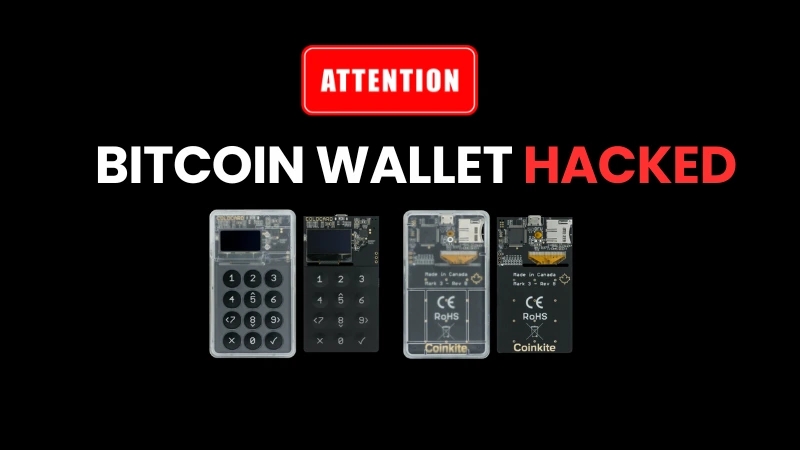
On July 31, 2026, over a thousand Bitcoin holders learned this the hard way. Attackers drained 594 BTC—approximately $38 million—from separate wallets in 25 minutes. The victims had not been phished. They had not typed their seed phrases into a malicious website. Most of these wallets had been dormant in safes for years.
The money is gone. You need to know why it happened and how to ensure you are not next.
Why randomness matters at all
Bitcoin cryptography has a developed concept of randomness. It is not about feeling secure or buying an expensive brand. It is the mathematical foundation of your ownership.
Every wallet starts as a large random number. If that number is truly unpredictable, guessing it is impossible. The universe will end before a computer brute forces a valid seed.
But if the random number generator is broken, the results are predictable. An attacker does not need to break into your house. They just search the much smaller pool of predictable numbers, calculate your private key, and sweep your funds.
That is exactly what happened. A bug in specific Coldcard firmware meant the device skipped its own hardware randomness generator. It produced weak seeds. Attackers found the pattern and emptied the wallets.
Three facts about your exposure, ranked
Run your own setup through these facts.
The model. The flaw specifically affects the Coldcard Mk3, though seeds generated on Mk4, Q, and Mk5 before the fixed firmware releases are also affected, offering only about 72 bits of entropy rather than the expected 128 bits.
The creation date. This is the distinction that matters most. Exposure depends on which firmware was running at the moment you generated your seed. It does not matter what firmware your device runs today. Updating your firmware right now does not retroactively fix a bad seed. The key material is already weak. The vulnerable window covers firmware versions 4.0.1 (March 2021) through 4.1.9 on the Mk3.
The signature type. Every wallet drained in this attack was single signature. The victims trusted one device from one manufacturer to hold their entire net worth. Furthermore, every drained wallet held more than 0.15 BTC.
Where the argument does not go
I am not going to tell you that self-custody is broken, because I do not think that is true and I think people who say it are overreaching.
Exchange failures have cost holders billions. The lesson here is not that self-custody is unsafe. The lesson is that depending entirely on a single piece of hardware is a failure of imagination. The Bitcoin network worked exactly as designed. It faithfully executed valid signatures from keys the attacker was able to reconstruct.
What I would say is that you can no longer assume your device is flawless. You have to design your security assuming the device might fail.
Security creates obligations
Here is the part crypto culture skips. Self-custody is not merely a right you exercise. It is a responsibility you bear, and you are the security team.
When a vulnerability drops, the obligation to fix it is yours alone. Sitting idle is negligence.
Identify your firmware. Find out exactly what firmware your Mk3 was running when the wallet was first created.
Treat weak seeds as compromised. If your seed was generated on an affected Mk3 (or before the fixed firmware on Mk4, Q, or Mk5), do not consider it at risk. Consider it compromised. The only exceptions are if you used a strong, unique BIP-39 passphrase or if you added at least 50 fair and independent dice rolls when creating the seed. Even then, experts recommend migrating to a new seed.
Move the funds immediately. Here is exactly what experts advise:
Do not update the firmware and assume you are safe. Firmware 4.2.0 corrects new seed generation, but it cannot repair a seed that was already generated by affected firmware.
Generate fresh keys. Create a brand-new wallet. Let it generate its own recovery phrase from scratch. Do not restore your existing recovery phrase into the new wallet.
Use a trusted device. If you have a different hardware wallet (like a Blockstream Jade or a new Coldcard running the patched firmware), use it. If your Mk3 is your only device, you can use it, but you must first update it to firmware 4.2.0 (or newer) and then generate an entirely new seed.
Verify everything. Verify the new receive address on the device screen itself.
Test, then send. Send a small test transaction first. Once confirmed, move the full balance.
Retire the old phrase. Once you have confirmed the old wallet is empty and the new one is working, permanently destroy the old backup. Never enter it into a website, form, or "checker" tool.
Do not wait for confirmation. The wallets drained this week were dormant. The attack cost the hacker nothing per additional target. You are not too small to be swept.
Solving the single point of failure
Back to where we started, because this is the part you can actually control.
If you hold a material amount of wealth, a single signature is no longer a defensible setup. You need to separate the existence of the asset from a single point of failure.
Use a multi-signature arrangement. A setup where two of three keys are needed, spread across devices from completely different manufacturers, survives a flaw in any one of them. If one device generates a weak seed, the attacker still cannot move the funds without the second signature.
This single change is probably responsible for saving more wealth than any brand loyalty.
The short version
Security means control, and control means understanding your tools. A hardware wallet is a useful tool that approximates cold storage. It is not infallible.
The Coldcard exploit proves that weak randomness can quietly undermine your custody for years. It comes attached to a lesson you are now responsible for applying. The specific way most people fail is not a physical theft. It is trusting a single piece of software without redundancy.
Check your device. Move your funds if you are exposed. Then build a setup that survives the next bug.
Contact us if you need help. Email: info@shariaquant.com What's App: +90 551 811 58 67