
Why Crypto Signals Fail the People Who Follow Them

ShariaQuant Team
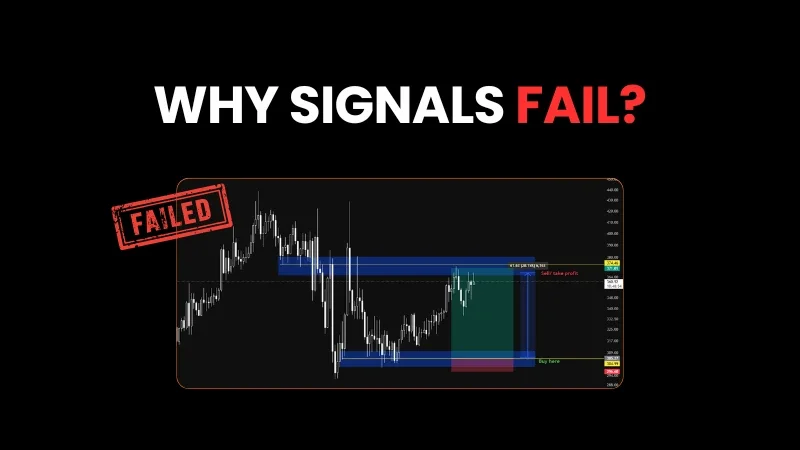
Somebody adds you to a Telegram group. Or a Discord. There are screenshots, there are green candles, and there is a man who seems to know exactly when to buy.
You pay. You follow the calls. Six months later you are down, and he is not.
The obvious explanation is that he was lying. Sometimes that is true. But it is not the interesting case, and it is not the common one. The common case is that the signals were fine and you still lost money, and until you understand why that happens, you will keep paying different men for the same outcome.
What the man sending the signal actually has
He is not selling you the thing that makes him profitable. He is selling you the output of it. Five things sit underneath that output and none of them transfer through a message.
Position sizing. He risks an amount calibrated to his account and his life. You see "BUY" and you decide the size yourself, usually based on how confident the message sounded. The same call, sized differently, is a different trade with a different outcome. This is the largest single reason two people following identical signals get opposite results, and it is invisible in the message.
A loss budget. He knows what a normal losing streak looks like because he has lived through several. He knows six losses in a row is Tuesday. You have never seen six losses in a row, so when it happens you conclude the system is broken, and you leave at the exact moment the sample size was becoming meaningful.
Emotional conditioning that took years. He has watched a position go 40% against him and held, or cut, according to a rule rather than a feeling. You have not. Nothing about receiving his conclusion gives you his stomach.
Context you cannot see. He entered because of something he noticed at a level three weeks ago. You entered because a notification arrived. He exits when the reason he entered stops being true. You have no reason to exit, because you never had a reason to enter, so you exit on fear or greed.
Execution timing. By the time you have read the message, unlocked your phone, opened the app and placed the order, the price has moved. His entry and your entry are not the same entry. Over enough trades, that gap alone can eat the edge.
Give a man a fish and you have made him dependent on you for fish. That is not a criticism of the fisherman. It is a description of the arrangement.
Then leverage turns a bad outcome into a permanent one
Most people following signals are not doing it on spot. They are on futures, on margin, using leverage, because small percentage moves are not exciting on a small account and leverage is the only way to make them exciting.
This is where a survivable mistake becomes an unrecoverable one.
On spot, a bad run is a bad year. The position is still there, you still own the asset, and you can wait. On leverage you get liquidated, and there is nothing left to recover with. You were not wrong about direction, necessarily. You were early, and early is fatal when you have borrowed.
There are two separate problems here and it is worth keeping them separate. Leverage is financially ruinous for people without experience, and that alone would be reason enough to avoid it. It is also riba, because you are paying a rate for the passage of time on borrowed exposure, and the swap-free accounts marketed to Muslims do not fix that, they only rename the fee.
So the signal follower using leverage has taken somebody else's judgement, sized it wrong, held it with no conviction, and financed it with something prohibited. The signals were never the weak link in that chain.
The blame loop
Six months in, the account is down. What happens next is predictable and it is the part that keeps people stuck.
They blame the man. He was fake, the group was a scam, crypto is rigged.
Sometimes correct. Frequently not, because the same calls made him money. He sized them properly, held them through the drawdown he expected, and exited on his own reason. Same information, opposite outcome, and the difference was everything the message did not contain.
The blame is comfortable because it explains the loss without requiring anything from you. It is also the reason the next group looks appealing, because if the problem was that man, then a better man solves it. So you pay again.
I am not asking you to blame yourself instead. That is just as useless. I am asking you to notice that the variable was never the signal, and any explanation that keeps the variable outside you will keep producing the same six months.
You are playing two different games and you have confused them
Almost everybody who arrives here wants two things at once, and they need completely different setups.
Game one: you want your savings to stop rotting. You are watching your money lose value and you want it in something that cannot be printed. This game does not require skill. It requires a screened asset, a schedule, and patience. Buy a fixed amount on a fixed date regardless of price, hold it, and stop looking. That is dollar-cost averaging, it suits spot-only constraints better than it suits anything else, and most people reading this should be doing only this.
Game two: you want to generate income from the market. This is a skill. It takes years, it has a failure rate, and it is closer to a profession than to an investment.
The disaster happens when somebody plays game two with game one's money. Rent money, savings, the emergency fund, all deployed on somebody's Telegram call because it was supposed to be quick. Now every trade carries a weight that guarantees bad decisions, and the pressure to be right immediately is exactly the pressure that makes people double down.
If you cannot say which game you are playing right now, that question has its own piece, and it is worth answering before you place another order.
Where the money is supposed to come from
Here is something the signal groups will never tell you, because their entire business depends on you not hearing it.
The market is not where you generate your first capital. It is where you protect and grow capital you generated somewhere else.
Your income comes from your work, your business, your skill, your trade. Bitcoin does not manufacture wealth out of a small account and a good entry. Either you transfer wealth in from what you earn, or you start receiving payment in crypto for work you actually do, and then the question becomes how to hold it well.
That reframing changes what you should be optimising. If the market is where wealth is preserved rather than created, then the highest-return activity available to you is increasing what you earn outside it, and the second is learning to not lose what you bring in. Neither of those is a signal group.
And practically: start with an amount whose loss changes nothing about your life. Not an amount that would be uncomfortable to lose. An amount that would be genuinely fine.
How to use signals properly, if you use them at all
There is a version of this that works, and it is nothing like what people do.
Treat the call as a question, not an instruction. Somebody says buy here. Before you do anything, open the chart yourself and ask why here. What is at this level. Is there structure. Did price leave this area quickly before. Write down your answer.
Then compare. Sometimes you will find nothing and that is information about the caller. Sometimes you will find the reason and you have learned to see it. And sometimes, once you have done this for a few months, you will find a better entry than the one you were given, because you were watching the level while he was asleep.
That day is the point of the whole exercise. Signals used this way are training data. Signals used as instructions are a subscription to somebody else's judgement, renewed monthly, forever.
Size at zero while you learn. Track the calls without money on them. If you cannot be disciplined about a hypothetical position, you will not be disciplined about a real one, and finding that out costs nothing this way. Our ninety-day practice plan is built around exactly this kind of unpaid repetition, and the risk rules are what you apply once real money is involved.
The uncomfortable part: doubt
Now the thing that is hardest to say, and it is the most important paragraph here.
Some people trade leverage and make money. Not many, but some, and pretending otherwise makes us look dishonest. Many of them are not Muslim. A few are.
Watch what they have in common. They have no internal conflict about what they are doing. No hesitation before entry, no guilt after, no part of them arguing that this is wrong. That certainty is a genuine operational advantage, because a divided mind hesitates, and hesitation in execution costs money.
So there is a person who is in the worst possible position: the Muslim who believes leverage is prohibited and uses it anyway. He does not have the conviction of the man who feels nothing about it, and he does not have the peace of the man who left it. He gets the risk without the clarity and the guilt without the abstinence. Every trade is argued with himself.
The tradition is direct about this state. Nu'man ibn Bashir narrated that the Prophet ﷺ said the lawful is clear and the unlawful is clear, and between them are doubtful matters, and that whoever grazes around the protected pasture will soon enter it (Bukhari and Muslim). And Hasan ibn Ali narrated: leave what makes you doubt for what does not make you doubt (Tirmidhi 2518, graded sahih).
Read the instruction carefully, because it is not what people assume. The remedy for doubt is not to suppress the doubt. It is to leave the doubtful thing and go and be certain about something else. You are supposed to end up with conviction. You just get there by choosing what you actually believe, not by silencing the part of you that objects.
This is also why our screener publishes a Doubtful verdict as a category of its own rather than rounding it to yes or no. Roughly a third of the assets we assess land there, and gharar is what puts them there. Doubtful is not a soft yes. It is the tradition's own middle category, and the guidance about it is to step back.
Provision is not a scoreboard
Which raises the question everybody thinks and few say out loud. If leverage is prohibited, why is that man making money and I am not?
The Qur'an answers this directly. In Surah Saba, Allah says He extends provision for whom He wills and restricts it, and that whatever you spend He will replace it, and He is the best of providers (34:39).
The classical commentary on this verse makes the point explicit, and it is the point you need: the abundance or restriction of provision is connected to Allah's will, not to His pleasure and approval. Wealth is not a certificate of divine approval, and difficulty is not a certificate of divine anger. Both believers and disbelievers receive provision under the same decree.
So a profitable leverage trader is not evidence that leverage is acceptable. It is evidence that provision is distributed by a decree that does not consult our theories. And your difficult year is not evidence that you chose wrong.
That is the release from the comparison, and it is why the honest version of this argument does not need the leverage traders to be losing. Some of them are not. It does not change what you should do.
What the money is for
There is a last piece, and it is the one that changes how the whole thing feels.
Wealth in this tradition is not a score to accumulate. It is a trust, and the verse above pairs the promise with an instruction: whatever you spend, He replaces it. Not whatever you hoard.
Spending here is wide. Your family. Your own education and skill, because a Muslim who can earn is more useful than one who cannot. People who are struggling, including people you will never meet in cities you will never visit, because the identity is not bounded by nationality and the believers are described as one body.
If wealth is a trust that circulates, then the entire signal-group proposition looks different. It is not merely a bad way to make money. It is the wrong shape of activity: extracting quickly, from a market, using borrowed exposure, in order to hold. Against a model that says earn genuinely, protect carefully, spend deliberately, and trust the replacement.
The uncomfortable diagnostic: if somebody claims to believe provision comes from Allah, and then behaves as though a Telegram channel is the source, the belief and the behaviour have separated. That separation is more damaging than any drawdown, and it is repaired by action rather than by intention.
Why we do not call our community a signals group
Because a signal makes you dependent, and dependence is the product.
We teach the method, we publish every verdict with the reasoning so you can disagree with us, and we would consider it a success if you eventually stopped needing us. The fiqh module is free and so is the community, because the argument for any of this should survive you checking it.
There is a longer piece on the six reasons Muslim traders lose money, and signals is only the second of them.
But if you take one thing from here, take this. You are not behind because you lack the right signal. You are behind because a signal was never the thing that was missing. Build the judgement, bring the capital in from your actual work, size it so a bad year is survivable, and let the timeline be years.
That is slower than what you were sold. It is also the only version that has ever worked.